VR Technology Boosts Exercise Participation in Children with Autism
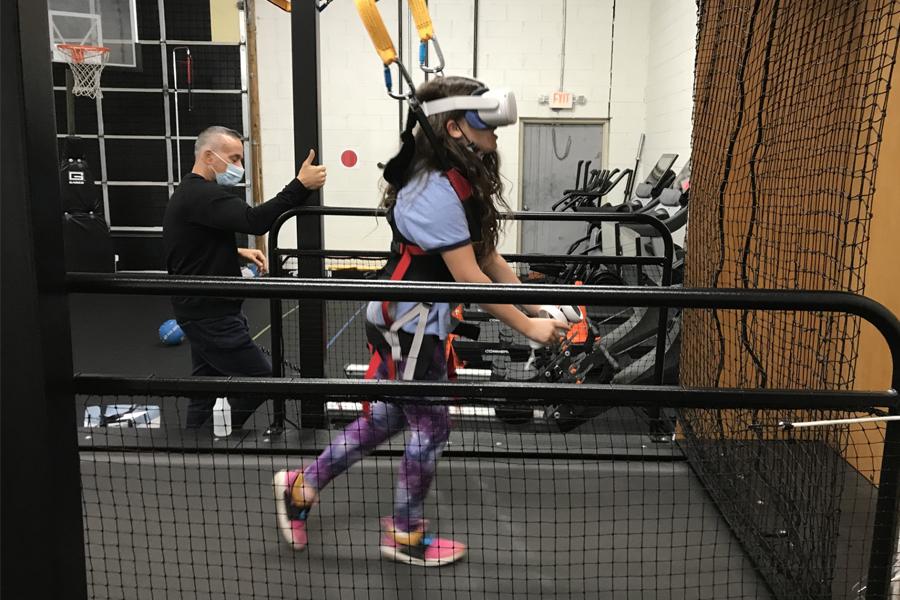
A recent study led by Associate Professor of Occupational Therapy **Alex Lopez** found that **virtual reality (VR)** can motivate children and adolescents with
Summary
A recent study led by Associate Professor of Occupational Therapy **Alex Lopez** found that **virtual reality (VR)** can motivate children and adolescents with **autism spectrum disorder (ASD)** to participate in more physical activity and exercise. The study, published in the journal **Frontiers in Virtual Reality**, demonstrated that **exergaming**, or using technology like VR to turn physical activities into a game, can help children with ASD stay active. The research took place at **Inclusive Sports and Fitness (ISF)**, a nonprofit gym in Holbrook, N.Y., and included 11 children and adolescents ages 8 to 19 diagnosed with Level One ASD. The study found that exercising with VR was significantly more energetically costly than exercise without VR, but participants did not perceive the exercise as more demanding. This study has implications for the use of VR in **occupational therapy** and **physical education** programs for children with ASD. For more information on ASD, visit [[autism-spectrum-disorder|Autism Spectrum Disorder]]. To learn more about the benefits of exergaming, check out [[exergaming|Exergaming]].
Key Takeaways
- The study found that exercising with VR was significantly more energetically costly than exercise without VR
- The study included 11 children and adolescents ages 8 to 19 diagnosed with Level One ASD
- The research took place at Inclusive Sports and Fitness (ISF), a nonprofit gym in Holbrook, N.Y.
- The use of VR technology can help to overcome the barriers that children with ASD often face in participating in physical activity
- More research is needed to fully understand the potential benefits and limitations of using VR technology in exercise and therapy programs for children with ASD
Balanced Perspective
The study's findings suggest that VR can be a useful tool for promoting physical activity and sports participation among children with ASD. However, more research is needed to fully understand the potential benefits and limitations of using VR in exercise and therapy programs for children with ASD. The study's small sample size and limited duration are limitations that need to be addressed in future studies. As noted by **Noah D. Chernik**, a student researcher on the study, "We believe that additional studies with larger populations will expand on these findings and further demonstrate how VR can provide occupational therapists and other healthcare professionals with a valuable tool for assisting neurodiverse populations." To explore the current state of research on VR and ASD, visit [[vr-and-asd-research|VR and ASD Research]].
Optimistic View
The study's findings are a significant breakthrough in the use of VR technology to promote physical activity and sports participation among children with ASD. The use of VR can help to overcome the barriers that children with ASD often face in participating in physical activity, such as poor motor coordination and difficulties with motivation and focus. As **Alex Lopez** notes, "By integrating VR into performance-based interventions, we've demonstrated how technology can amplify motivation, support sensory needs, and create more accessible pathways to movement and wellness." This study has the potential to improve the lives of children with ASD and their families. To learn more about the benefits of VR for children with ASD, visit [[vr-for-asd|VR for ASD]].
Critical View
While the study's findings are promising, there are several limitations and potential drawbacks to consider. The study's small sample size and limited duration may not be representative of the broader population of children with ASD. Additionally, the use of VR technology may not be accessible or affordable for all families, which could exacerbate existing health disparities. As **Santiago Gonzalez**, an alumnus and researcher on the study, notes, "We need to consider the potential barriers to accessing VR technology and ensure that our interventions are inclusive and equitable." To learn more about the challenges of implementing VR programs, visit [[vr-program-implementation|VR Program Implementation]].
Source
Originally reported by New York Institute of Technology